The Water Problem
In India we either experience water scarcity ourselves or hear about it in the news every summer. This has been a perennial problem since colonial times. What’s different is how we imagine “scarcity”. That conjures up an image of sand dunes and Rajasthani women carrying many matkas on their heads.
But the water problem isn’t only centered on geographical problems such as low precipitation. It’s penetrated the urban centers and rural areas which in the past had plenty of water.
This prompted the government to come with solutions that seemed fit to it. The chapter basically outlines the genesis of Multi-purpose projects aka Dams and the problems associated with them. Then it goes on to talk about water harvesting and its various forms in India. Frankly, the solutions feel outdated in the chapter. The investment in our water infra is abysmal for mid to small cities and non-existent for towns. That’s the biggest issue rather than dams or water harvesting.
Circumstances of Scarcity
You have two situations of scarcity :
1. Low quantity of Water
India has both problems in different regions. The increasing urban concentration has aggravated the problems of water access due to availability issues. The population needs more water for not only drinking but other jobs such as cleaning and irrigation which is the largest consumer of water. This leads to installment of personal water pumps for houses and tube-wells for farms in the absence of a public water distribution system.
This leads to over-exploitation of an already mismanaged, precious resource. After Independence, India’s water needs increased significantly due to :
- Concentration of Population in Cities
- Industrialization
- Irrigation
- Hydroelectric Plants
2. High quantity of Water but Bad Management
In the absence of a good water distribution system, the people are also vulnerable to various water borne diseases. To tackle this issue in rural areas, the government started the scheme called Jal Jeevan Mission (JJM) to ensure that every rural household gets 55 liters of water per capita per day on a long-term basis.
If the scheme doesn’t go as planned and the exploitation continues then this will result in ecological disaster.
Multi-Purpose River Projects
A dam is a barrier across flowing water that obstructs, directs or retards the flow, often creating a reservoir, lake or impoundment. “Dam” refers to the reservoir rather than the structure. Most dams have a section called a spillway or weir over which or through which it is intended that water will flow either intermittently or continuously. Dams are classified according to structure, intended purpose or height. Based on structure and the materials used, dams are classified as timber dams, embankment dams or masonry dams, with several subtypes. According to the height, dams can be categorised as large dams and major dams or alternatively as low dams, medium height dams and high dams.
Multi-purpose projects or Multi-purpose river projects generally refer to dams. They’re called ‘multi-purpose’ due to their use in :
- irrigation
- power generation
- industrial water supply
- recreational activities
- inland navigation
- fish breeding
For example:
Sutluj-Beas river basin’s Bhakra-Nangal project uses its water for hydel-power generation and irrigation.
Similarly, the Hirakund Dam helps with conservation of water and flood control.
Initially the dams were seen as the conerstone on which the progress of India was to be laid. But eventually, the problems around started coming to light.
Dams are the temples of modern India. — Jawaharlal Nehru
In recent years they’ve come under scrutiny due to :
- Displacement of locals
- Causing ecological damage
- Poor sedimentation flow causing land fertility issues
- Rockier sea beds due to excessive sedimentation at the bottom of the reservoir
- Submerging existing flora and soil leading to their decomposition
- Inducing earthquakes, causing pollution, pests and water borne diseases
Due to high availability of water in some states, farmers have changed cropping patterns to prefer water intensive crops which causes further overuse.
Rainwater Harvesting
The disadvantages of multi-purpose projects points to another probable solution, that is rain water harvesting. This practice has been followed for centuries in India. Like in :
- The ‘Guls’ or ‘Kuls’ of the Western Himalayas for agriculture.
- Rooftop rainwater harvesting to store drinking water in Rajasthan.
- In the flood plains of Bengal, people built flood channels to irrigate their fields.
- ‘Khadins’ in Jaisalmer and ‘Johads’ in other parts of Rajasthan.
Tankas
In the semi-arid areas of Rajasthan like Bikaner, Barmer etc. traditionally all houses had tanks for water storage, called tankas. These tankas could be as big as a room. The largest found was 6.1m × 4.27m × 2.44m.
These tankas were connected with an rainwater harvesting system, generally built inside the house. The rainwater on the flat roofs was supposed to trickle down into these tankas through pipes.
The first rain isn’t collected as this would clean the roofs and the pipes. Subsequent showers are then collected.
This rainwater, also called palar pani, is considered the purest form of water. These reservoirs would also keep their adjoining rooms cool. Though this practice is fast disappearing in Rajasthan due the Indira Gandhi Canal. However, it’s being adopted in many other rural and urban parts of India.
NOTE : Tamil Nadu is the first state in India which has made rooftop rainwater harvesting structure compulsory to all the houses across the state. There are legal provisions to punish the defaulters.
In Gendathur, a remote backward village in Mysuru, Karnataka, villagers have rainwater harvesting systems on their roofs.
Nearly 200 households have installed this system and the village has earned the rare distinction of being rich in rainwater.
Gendathur receives an annual precipitation of 1,000 mm, and with 80 per cent collection efficiency and of about 10 fillings, every house can collect and use about 50,000 litres of water annually.
From the 200 houses, the net amount of rainwater harvested annually amounts to 1 lakh litres.
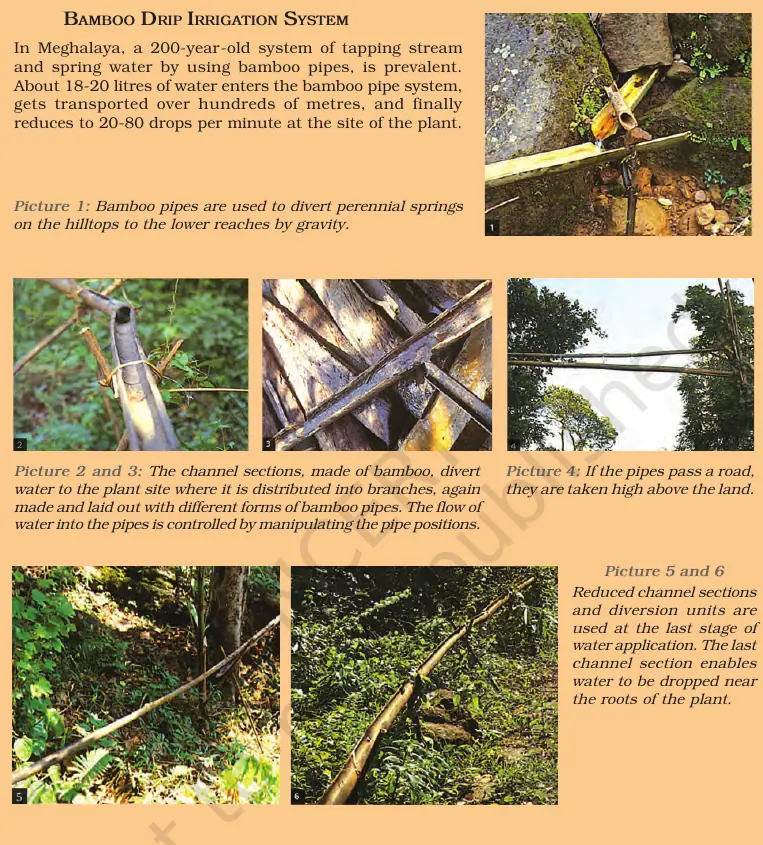
Bamboo Drip Irrigation System