The transformation of chemical substance into another chemical substance is known as chemical reaction.
For example: Rusting of iron, the setting of milk into curd, digestion of food, respiration, etc.
Parts of A Reaction
In a chemical reaction,the new substances formed are completely different in terms of chemical properties from the original substance, so in a chemical reaction.
Therefore, chemical change takes place. This is due to rearrangement of atoms in a chemical reaction.
- The substances which take part in a chemical reaction are called reactants.
- The new substances produced as a result of a chemical reaction are called products.
Burning of Magnesium
The burning of magnesium in the air to form magnesium oxide is an example of a chemical reaction.

Magnesium Oxide formation
Before burning, the magnesium ribbon is cleaned by rubbing with sandpaper. This is done to remove the protective layer of basic magnesium carbonate from the surface of the magnesium ribbon.
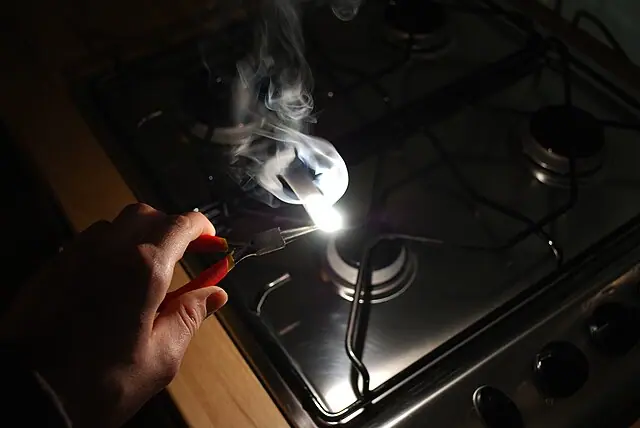
Magnesium giving off a sparkly light.
Here, the reactants are Magnesium and Oxygen while the product is Magnesium Oxide.
Characteristics of Chemical Reactions
Evolution of gas
The chemical reaction between zinc and dilute sulphuric acid is characterised by the evolution of hydrogen gas.

Zinc and dilute sulphuric acid reacting, liberating hydrogen gas
Change in Colour
Coloured potassium permanganate solution is characterised by a change in colour from purple to colourless. The chemical reaction between sulphur dioxide gas and acidified potassium dichromate solution is characterized by a change in colour from orange to green.
Change in state of substance
Characterised by a change in state from solid to liquid and gas (because the wax is a solid, water formed by the combustion of wax is a liquid at room temperature whereas, carbon dioxide produced by the combustion of wax is a gas). There are some chemical reactions which can show more than one characteristics.
Change in temperature
The chemical reaction between quick lime and water to form slaked lime is characterized by a change in temperature (which is a rise in temperature). The chemical reaction between zinc granules and dilute sulphuric acid is also characterised by a change in temperature (which is a rise in temperature).

Quick lime reacting with water to form slaked lime
Formation of Precipitate
The chemical reaction between sulphuric acid and barium chloride solution results in the formation of a white precipitate of barium sulphate. This is a type of double displacement reaction.
Example Reaction:

Barium Chloride and sulphuric Acid result in a precipitate Barium Sulphate
- Key Takeaway: Precipitation reactions occur when two aqueous solutions combine to form an insoluble solid (precipitate).
Understanding Chemical Equations
A chemical equation represents the reactants and products in a chemical reaction using symbols and formulas. This provides a concise and informative way of expressing the reaction.
General Format of a Chemical Equation

General formula of chemical reactions
- Reactants: A and B
- Products: C and D
- Arrow: Indicates the direction of the reaction.
Types of Chemical Equations
Chemical equations can be categorized into balanced and unbalanced:
Balanced Chemical Equation
- Definition: The number of atoms of each element is equal on both sides of the equation.
- Example:
An example of a balanced chemical equation.
- According to the Law of Conservation of Mass, mass is neither created nor destroyed in a chemical reaction, so the number of atoms should balance.
Unbalanced Chemical Equation
- Definition: The number of atoms of each element differs on both sides.
- Example:

An example of an unbalanced chemical equation.
- To balance this, you must adjust the coefficients of each substance.
Balancing a Chemical Equation
Steps to Balance:
- Write the equation:
An example of an unbalanced chemical equation.
- Create a table to track the number of atoms on both sides.
| Name of Atom | No. of Atoms in Reactant | No. of Atoms in Product |
|---|---|---|
| Iron | 1 | 3 |
| Hydrogen | 2 | 2 |
| Oxygen | 1 | 4 |
Now, remember, only coefficients can be changed and not the subscripts.
Multiply with coefficients until both sides have the same number of the same kind of atoms.
| Name of Atom | No. of Atoms in Reactant | No. of Atoms in Product |
|---|---|---|
| Iron | 1 * 3 = 3 | 3 |
| Hydrogen | 2 * 4 = 8 | 2 * 4 = 8 |
| Oxygen | 1 * 4 = 4 | 4 |
In balancing oxygen, we also increased the number of hydrogen on the LHS from 2 to 8, so we have to account for that on the RHS and add a 4 there as well.
Final balanced equation:

An example of an unbalanced chemical equation.
Making Chemical Equations More Informative
You can make chemical equations more informative by including the physical states of the substances and any conditions under which the reaction occurs.
States:
- Solid = (s)
- Liquid = (l)
- Gas = (g)
- Aqueous solution = (aq)
Conditions: Write them above or below the arrow.
Types of Chemical Reactions
Chemical reactions are classified into various types based on how the reactants and products interact:
Combination Reaction
- Definition: Two or more reactants combine to form a single product.
- Example:
Magnesium Oxide formation
Decomposition Reaction
- Definition: A single compound breaks down into two or more simpler substances.
- Example:
1. Calcium Carbonate breaking down into Calcium Oxide.

Calcium Carbonate breaking down into Calcium Oxide and Carbon dioxide
2. When Ferric Gydroxide is heated, it decomposes into Ferric Oxide and water.

Ferric Oxide is heated, it decomposes into Ferric Oxide and water.
- Types of Decomposition
1. Thermal: Heat causes decomposition.

Lead Nitrate breaking down into Lead Oxide, Nitrogen dioxide and Oxygen.
2. Electrolytic: Electricity causes decomposition.

Water breaking down down into Hydrogen and Oxygen after electrolysis.
3. Photolysis: Sunlight causes decomposition.

Water breaking down down into Hydrogen and Oxygen after electrolysis.
Displacement Reaction
- Definition: One element replaces another in a compound.
- Example:
Zinc + Copper Sulfate → Zinc Sulfate + Copper
Double Displacement Reaction
- Definition: Ions of two compounds exchange places to form new compounds.
- Example:
Barium Chloride and sulphuric Acid result in a precipitate Barium Sulphate
- Types:
1. Precipitation Reaction: A type of double displacement reaction where a precipitate forms. Like the example of Barium Chloride and Sulphuric Acid above .
2. Neutralization Reaction: The reaction in which an acid reacts with a base to form salt and water by an exchange of ions is called neutralization Reaction.

Sodium Hydroxide and Hydrochloric Acid reacting to form common salt and water.
Oxidation and Reduction Reactions
- Oxidation: The addition of oxygen or the loss of hydrogen.
- Reduction: The loss of oxygen or the gain of hydrogen.
The reaction in which oxidation and reduction both happen simultaneously is called Redox reaction.
Agents
- The substance which gives oxygen for oxidation is called an oxidizing agent.
- The substance which gives hydrogen for reduction is called a reducing agent.

Copper gets reduced while Hydrogen gets oxidized.
Exothermic vs. Endothermic Reactions
Exothermic Reactions:
- Definition: Reactions that release energy, typically in the form of heat.
- Example:

Carbon and Oxygen react to form Carbon dioxide and release heat, making this reaction exothermic.
Endothermic Reactions
- Definition: Reactions that absorb energy, typically in the form of heat.
- Example:

Zinc Carbonate heated to breakdown into Zinc Oxide and Carbon dioxide
Oxidation Reactions in Daily Life
Oxidation is either the gain of oxygen or the loss of hydrogen.
Corrosion
- Definition: The slow conversion of metals into undesirable compounds due to their reaction with air, moisture, or acids.
- Example: Rusting of iron (iron reacts with oxygen and moisture to form iron oxide).
Methods to Prevent Corrosion
1. Painting
2. Greasing and oiling
3. Galvanization
Rancidity
- Definition: The undesirable change in taste and odor of food containing fats and oils due to oxidation.
Methods to Prevent Rancidity
1. Adding antioxidants
2. Vacuum packing
3. Nitrogen packing
4. Refrigeration